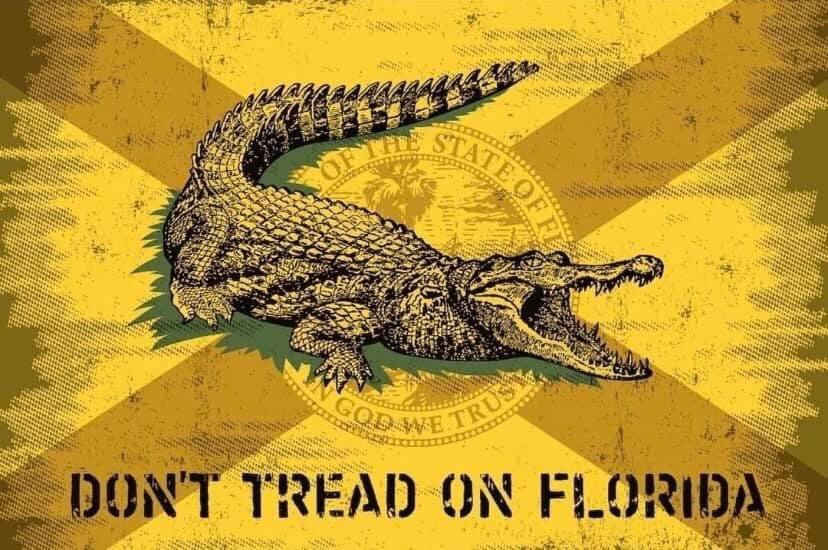
Can we call ourselves, the Free State of Florida, if we live under constant surveillance; or if the people we vote for ignore the will of We the People?
VIERA, Fla. — From the Government Center here to the last traffic light on A1A, Florida still calls itself the Free State.
The slogan is on bumper stickers, campaign mailers and the lips of every Republican who wants a job in Tallahassee. On the Space Coast it is more than branding. It is a question neighbors are asking out loud. Can Brevard County — and the rest of Florida — still claim that name while living under 24-hour, AI-driven tracking of cars, neighborhoods and soon the digital infrastructure that stores the rest of our lives? Can we claim it when the officials voters sent to office by historic margins treat privacy as an afterthought and “We the People” as a slogan for November, not a job description in January?
Gov. Ron DeSantis leaves office in January 2027. The constitution is clear: two consecutive four-year terms, then a gap. He cannot run in November. The era that made Florida a national symbol of pushback against lockdowns, federal overreach and cultural capture is ending. What replaces it is not yet a movement. It is a machine.
That machine is the Florida Republican Party as it now exists — funded, fractured and too often uninterested in the liberty voters thought they were buying.
The voters delivered. The representation did not.
Floridians did not whisper. They voted.
Republicans now lead Democrats in active voter registration by more than 1.5 million. They hold every statewide office. They hold supermajorities in the House and Senate. President Donald Trump carried the state by 13 points in 2024. In 2022, DeSantis won by nearly 20. Brevard has long been part of that red wall. The map is not ambiguous. The mandate was not subtle.
A conservative electorate asked for limited government, secure borders, cheap energy, parental rights and a state that would not treat its own citizens as suspects. What it is getting, in too many counties and too many committee rooms, is a party that talks like Reagan and legislates like a vendor.The Republican Party of Florida spent the summer fighting itself. DeSantis publicly blasted party Chairman Evan Power over a rigged debate process that all but crowned U.S. Rep. Byron Donalds.
Candidates attacked one another. A would-be contender was disinvited. Some Republicans have even drifted toward Democrat David Jolly, citing data-center money and a sense that Tallahassee now answers to donors before voters. A party that once defined itself against the administrative state is showing the symptoms of one.
That is not “the other side.” That is our side failing the people who built the majority.
On the Space Coast, the cameras never clocked out. The most concrete example has been sitting on poles along Interstate 95, State Road 528, South Patrick Drive and neighborhood entrances from Titusville to Palm Bay.
Flock Safety and similar vendors sell automated license plate readers — cameras that photograph every vehicle that passes, record plate, make, model, color, time and direction, and dump the data into a searchable network. Police praise them for finding stolen cars and missing people. Fair enough. Tools that catch criminals are not the enemy.The problem is the architecture. These systems do not watch suspects. They watch everyone.
They run around the clock. They use artificial intelligence. They retain location histories.
Agencies share access with other agencies, sometimes across state lines, sometimes with more than a thousand organizations. Private parties — homeowners associations, apartment complexes, businesses — install the same hardware and can feed the same pools. Crowd-sourced maps have documented more than 240 such readers in Brevard alone.
Residents have already asked the obvious question: Who knows when I am not home?
Abuse is not theoretical, and it is not only someone else’s county. In Haines City, an officer searched his estranged wife’s plate 717 times. Here at home, Brevard County’s 2025 Deputy of the Year, Michael Fultz, was found by internal investigators to have queried his ex-girlfriend’s tag in the Flock system before a shift and logged it as an “investigation.” He resigned in May as Sheriff Wayne Ivey prepared to fire him for what the agency called egregious misconduct. One search is not 717. It is enough to prove the point: When a database of ordinary movement exists, someone will use it for something other than a homicide.
DeSantis finally said the quiet part out loud.
In late August he called the technology “out of control” and warned against a “digital AI surveillance state where everything we’re doing is being tracked at all times.”
His example was a trip to Buc-ee’s. “It’s really none of the government’s damn business,” he said. On Aug. 31, the Florida Department of Transportation revoked permits for license plate readers on state highway rights-of-way and gave agencies 30 days to take them down. That was the right move. It was also incomplete.
Brevard did more than the memo required — and less than the problem demands. Ivey announced the same day that the Sheriff’s Office was terminating its Flock program, pulling agency cameras off I-95 and SR 528 and cutting access to the broader Flock database, including feeds from private property. Titusville, Melbourne and Indian Harbour Beach paused their programs. Palm Bay, Brevard’s largest city, is the local exception that proves the gap in the law: It briefly suspended 51 cameras over permitting, then switched them back on Aug. 24. Those readers sit on city streets. The state order does not touch them. Police Chief Jeff Spears has said he wants more.
The data already collected does not vanish because a pole comes down. A future administration can flip the FDOT switch back. The Legislature has not passed a comprehensive statute on retention, warrants, audits, out-of-state sharing or private-to-police pipelines.
Florida Statute 316.0777 already limited how ALPRs can be used for tickets. It did not build a Fourth Amendment wall. The next session will write the real rules — or it will write nothing, and the network will grow again on every road the state does not own.
U.S. Rep. Greg Steube, a Florida Republican, has introduced federal legislation to bar federal agencies from tapping these networks without a warrant and to condition Justice Department grants on similar state rules. That is the correct instinct. Warrantless, suspicion-less tracking of law-abiding drivers — including the ones leaving Kennedy Space Center, Port Canaveral or a Viera grocery run — is not “public safety.”
It is a file on every citizen who owns a car.
Data centers are not just warehouses
Call them data centers if you want the real-estate brochure. Call them what they functionally are when they sit at the intersection of AI, government contracts and persistent collection: surveillance infrastructure with a power bill. Florida is in a national scramble to host the buildings that train and run large models.
They gulp electricity and water. They raise rates if utilities socialize the cost. They change the character of counties that never voted to become Northern Virginia.
Residents from Citrus to Polk to Miami-Dade have packed meetings. Counties have piled on moratoriums. DeSantis signed SB 484 this year to stop utilities from dumping hyperscale costs onto households, to protect aquifers and to preserve local authority to say no. That law is a floor, not a finish.
Brevard is not a hyperscale hotspot — yet. County commissioners this spring denied tax exemptions for data centers, citing thin job creation and strain on infrastructure. That was a local stand worth noticing. It will not hold if Tallahassee treats “growth” as an argument against asking who stores what, who queries whom and under what legal standard.
Donalds, now the Republican nominee, says he is not anti-data center.
He wants ratepayer protection, on-site power, recycled water and local control. Jolly wants a moratorium. Primary rivals attacked Donalds for industry money. Voters can sort the candidates. What they should not accept is a party that shrugs while private compute and private camera networks grow up side by side.
Freedom-loving people on the Space Coast are not Luddites. This county put men on the moon.
They are against a government-adjacent stack that records movement first and invents a justification later.
The Fourth Amendment is not a suggestion
The Fourth Amendment is short on purpose. The people are to be secure in their persons, houses, papers and effects against unreasonable searches and seizures. Warrants require probable cause.
Florida’s Constitution, Article I, Section 12, tracks that guarantee and requires state courts to construe it in conformity with the U.S. Supreme Court’s reading of the Fourth Amendment.
For years, governments argued that a license plate in public is fair game — no expectation of privacy, no search. That was easier when a cop glanced at a tag. It is a different animal when a private vendor stitches cameras from Palm Bay to Titusville into a retrospective map of a person’s life.
The Supreme Court in Carpenter v. United States (2018) held that accessing historical cell-site location information is a search.
In June 2026, in Chatrie v. United States, the Court extended that logic to stored digital location data held by a third-party tech company, even for a limited time. The mosaic of a person’s movements is not “plain view.” It is a record.
Courts have not issued a final nationwide ruling that every Flock query is a Carpenter search. The direction of the law is obvious. The direction of Florida statute is not.
Conservatives used to understand this.
The same people who reject a federal gun registry should reject a de facto travel registry. The same people who fought vaccine passports should fight a system that can reconstruct who attended a rally, a church, a clinic or a Saturday at Ron Jon. Limited government is not a vibe. It is a prohibition on collecting first and asking later.
If “Free State of Florida” means anything in Brevard County, Florida, it means the county and the state do not get a continuous feed of the innocent.
What We the People still own
DeSantis used executive and departmental power late. He used it after years of contracts, grants — including immigration-enforcement money that helped buy readers — and local deployments that outran the politics. Credit the correction. Do not confuse it with a completed war.
Ivey’s decision to cut private-feed access was stronger than the state’s.
Palm Bay’s decision to keep rolling is a reminder that local government can still choose surveillance when the statute is silent.
The next governor, whoever wins Nov. 3, will inherit a party that can pass almost anything and an electorate that expected something more than branding. The Legislature still has to answer basic questions:
- How long may plate and vehicle data be kept when there is no case?
- When is a warrant required to query a network?
- May private HOAs and landlords pipe neighborhood movements into police systems without meaningful consent?
- May Florida data be searched by out-of-state or federal agencies as a matter of course?
- Will data-center permits come with hard rules on public power, water and the secondary market in information?
If Republican majorities will not write those rules, they should stop calling themselves the party of the Constitution.
Voters who delivered a 1.5-million registration advantage did not do it so Tallahassee could subcontract liberty to a Georgia vendor and a server farm.Florida became the Free State in the public mind because it said no when other states said yes — no to indefinite emergency rule, no to medical mandates as a condition of living, no to schools that hid children from parents.
That spirit does not retire with DeSantis.
It either lives in the next Legislature, the next governor and the next meeting of the Brevard County Commission, or it becomes a museum label next to a rocket.The cameras are still up on city streets. The databases still exist. The buildings are still being proposed on land that used to grow citrus and cattle.
The people who vote here still have the last word, but only if they use it.
Call your representative. Show up at the commission chambers. Ask Palm Bay, Melbourne and Titusville, by name, whether a warrant is required before the state reconstructs your week. Ask whether “Free State” is a tourism slogan or a legal standard.
A free people can live with police who solve crimes. They cannot live with a government that assumes every driver on I-95 is a lead. If the party that owns Florida will not draw that line, the voters who built the majority will draw it for them — at the ballot box, and in the only language Tallahassee still understands.
Leave a Reply
You must be logged in to post a comment.